
Summary: The right patio umbrella size depends on your table dimensions and seating layout. In most cases, your umbrella should extend at least 2 feet (60 cm) beyond the table edge on all sides. For example, a 48-inch table typically pairs with a 9 ft (2.7 m) umbrella.
Before purchasing a patio umbrella, most people compare fabric quality, frame material, color, and price. However, one of the most important and most commonly overlooked factors is size.
Choosing the right umbrella size is not as straightforward as it seems. The dimensions of your patio table, the number of seats, the table shape (round, square, or rectangular), and even the angle of the afternoon sun all influence how much usable shade you actually get.
In this guide, we simplify the decision process with 3 easy-to-understand charts. You’ll find a practical patio umbrella size chart, shade coverage references, and step-by-step guidance from LIDA OUTDOOR’s patio product expert to help you quickly determine the right umbrella size for your outdoor space, whether it’s a balcony, dining patio, deck, or lounge area.
Patio Umbrella Size Charts (Quick Reference Guide)
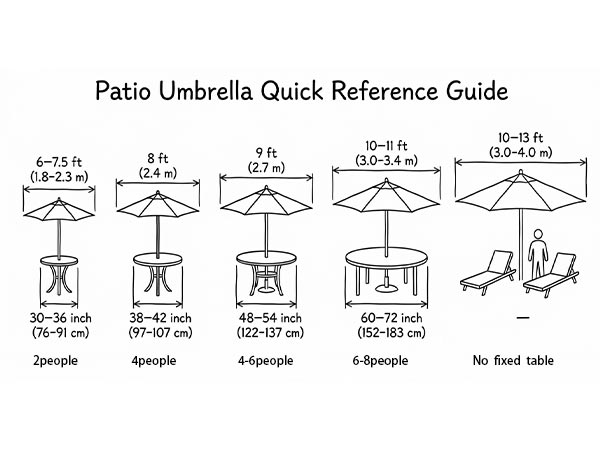
You can use the quick-reference chart below to get a clear overview of how patio table dimensions correspond to recommended umbrella sizes.
Chart 1. Quick Reference Size
Based on years of manufacturing and product experience, we’ve matched common patio table sizes with suitable umbrella diameters. This chart provides a practical starting point for choosing the right size.
| Table Size (inch/cm) | Recommended Umbrella (ft / m) | Seats | Typical Use |
| 30–36 in (75–90 cm) | 6–7.5 ft (1.8–2.3 m) | 2 | Balcony, café table |
| 38–42 in (95–107 cm) | 8 ft (2.4 m) | 4 | Small patio dining |
| 48–54 in (120–140 cm) | 9 ft (2.7 m) | 4–6 | Standard backyard dining |
| 60–72 in (150–180 cm) | 10–11 ft (3–3.3 m) | 6–8 | Large deck or outdoor dining |
| No fixed table | 10–13 ft (3–4 m) | — | Lounge set, sectional seating |
As a general rule, your umbrella should extend approximately 2 feet (60 cm) beyond the edge of your table to ensure consistent shade coverage throughout the day. Larger umbrellas may also require heavier bases for stability, especially in open or windy areas.
This chart is only the first step. In the next section, we’ll break down how umbrella diameter affects actual shade coverage and base weight requirements. This will help you determine when a size is sufficient and when it’s better to choose one size larger.
Chart 2. Shade Coverage Area & Recommended Base Weight
Choosing the right patio umbrella size is not only about diameter; it also requires understanding actual shade coverage and stability requirements.
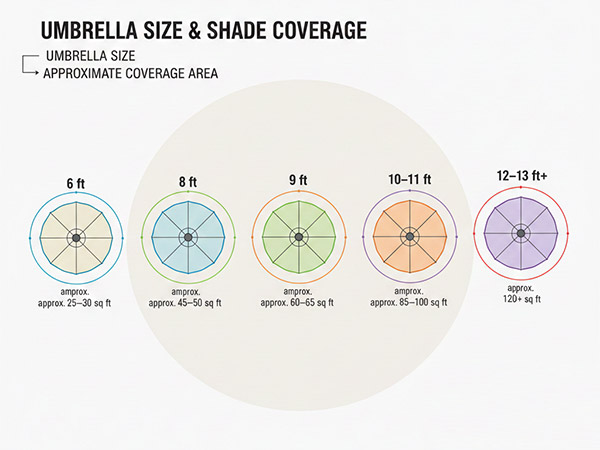
Shade coverage area
It’s important to note that shade performance is influenced by factors beyond canopy diameter. Pole position, furniture layout, and the sun’s angle throughout the day all affect the amount of usable shade you experience. The same umbrella size can feel very different depending on the setting.
Base weight should always be considered
As umbrella size increases, wind exposure also increases. A larger canopy captures more wind, making base stability even more critical. If the base weight is insufficient, the umbrella may wobble or even tip over, regardless of whether the size is correctly selected.
For this reason, shade coverage and base weight should always be considered together when selecting an umbrella.
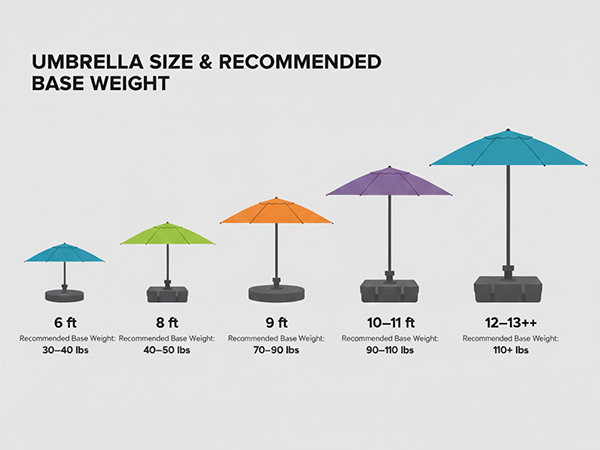
Approximate Shade Coverage & Recommended Base Weight
| Umbrella Size (ft / m) | Approx. Shade Coverage (sq.ft/m²) | Recommended Base Weight (lbs/kg) |
| 6 ft (1.8 m) | 25–30 sq ft (2.3–2.8 m²) | 30–40 lbs (14–18 kg) |
| 8 ft (2.4 m) | 45–50 sq ft (4.2–4.6 m²) | 40–50 lbs (18–23 kg) |
| 9 ft (2.7 m) | 60–65 sq ft (5.6–6 m²) | 70–90 lbs (32–41 kg) |
| 10–11 ft (3–3.3 m) | 85–100 sq ft (7.9–9.3 m²) | 90–110 lbs (41–50 kg) |
| 12–13 ft+ (3.6–4 m+) | 120+ sq ft (11+ m²) | 110+ lbs (50+ kg) |
Important Notes: The recommended base weights above apply to standard center-pole (market) umbrellas.
- For cantilever umbrellas, or in open areas with noticeable side winds, a heavier base or ground anchoring system is strongly recommended.
- In high-wind regions or fully exposed environments (such as open patios or coastal areas), consider increasing the base weight by 10–20% above the standard recommendation to improve safety and stability.
Chart 3. Choosing the Right Umbrella Size Based on Table Shape
Different table shapes create different exposure points. Some areas are more likely to receive direct sunlight, especially at the corners or ends of the table. That’s why the table shape should always be considered when selecting a patio umbrella.
Quick Reference: Umbrella Size Logic by Table Shape
| Table Type | Key Consideration | Recommended Sizing Logic |
| Round table | Ensure even coverage across the table and seating | Umbrella diameter ≥ table diameter + 4 ft (about 2 ft / 60 cm per side) |
| Square table | Check whether all corners remain shaded | Often requires one size larger than a round table of similar width |
| Rectangular table | Ensure both ends of the table are shaded | Consider a larger diameter umbrella or a rectangular / cantilever umbrella |
| No table (sofa/lounge area) | Shade the entire activity zone, not just a single point | 10 ft (3 m) or larger is typically more suitable |
Practical Considerations: In real-world use, a patio umbrella is not meant to shade only the table-top. You must also account for:
- Chairs pulled back from the table
- Movement space around the seating area
If your umbrella includes a tilt function, it can help adjust the shade direction throughout the day. However, tilt alone often cannot fully compensate for undersizing, especially in the late afternoon when the sun angle is lower. This is why, in open environments, a slightly larger umbrella often provides noticeably more consistent shade.
Frequently Asked Questions
FAQ 1:How do you measure a patio umbrella?
Follow these points to measure your patio umbrella correctly:
- Fully open the umbrella. Make sure the canopy is completely extended before measuring. Measuring a closed umbrella will give inaccurate results.
- Measure across the widest point. For round umbrellas, measure from one edge of the canopy to the opposite edge. This measurement gives you the umbrella diameter.
- Measure each side of the umbrella for square or rectangular umbrellas. If the umbrella is square or rectangular, measure the length of each side instead of the diameter.
- Check pole diameter (optional but important). Measure the center pole diameter to ensure compatibility with your table hole or umbrella base.
FAQ 2:What size umbrella do I need for a 48-inch table?
A 48-inch (120 cm) patio table typically requires a 9 ft (2.7 m) umbrella to provide full shade coverage. This size extends about 2 feet (60 cm) beyond the table edge on all sides, ensuring that all 4-6 seats remain shaded throughout most of the day.
A smaller 8 ft umbrella may technically cover the tabletop, but it often fails to shade seated guests, especially in the afternoon when the sun angle is lower. That’s why, for balanced coverage and comfort, a 9 ft umbrella is considered the safest and most practical choice.
Another case – if your patio is open and exposed to wind, or if chairs are frequently pulled back for additional space, upgrading to a 10 ft (3 m) umbrella can provide more consistent shade coverage. However, larger umbrellas require heavier bases for stability.
Conclusion
Ultimately, umbrella size sets the baseline for your overall shade experience. By considering table dimensions, table shape, actual shade coverage, and appropriate base weight, you can systematically determine the right patio umbrella size for your outdoor space.
By combining the three core reference charts in this guide with the simple “+2 ft per side” rule, most sizing decisions can be made with confidence before purchase. The goal is not just to select the correct diameter, but to ensure your shade solution performs consistently, providing comfort, stability, and safety during everyday use.
If you are sourcing patio umbrellas for wholesale or bulk orders, LIDA OUTDOOR can provide professional recommendations tailored to your application, climate, and purchasing requirements. Feel free to contact us for tailored support.