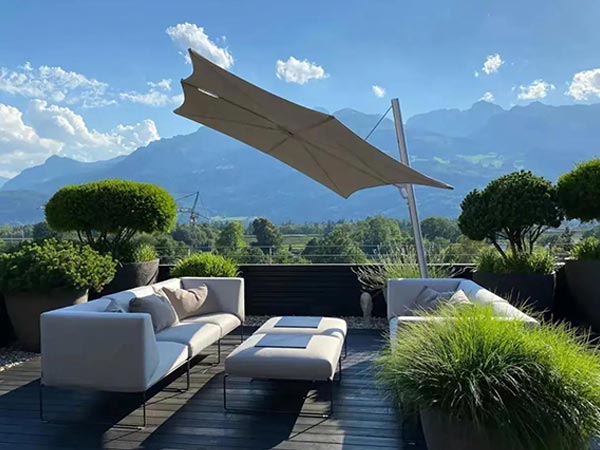

Cantilever umbrellas are popular for their aesthetic appeal and efficient use of space. However, their distinct structure – featuring a rigid, offset support – makes them less stable in wind than standard center-post garden umbrellas. Despite this, with the right choice and proper use, a cantilever umbrella can offer better wind resistance. But a crucial question remains: what is the actual limit of their wind-bearing capacity?
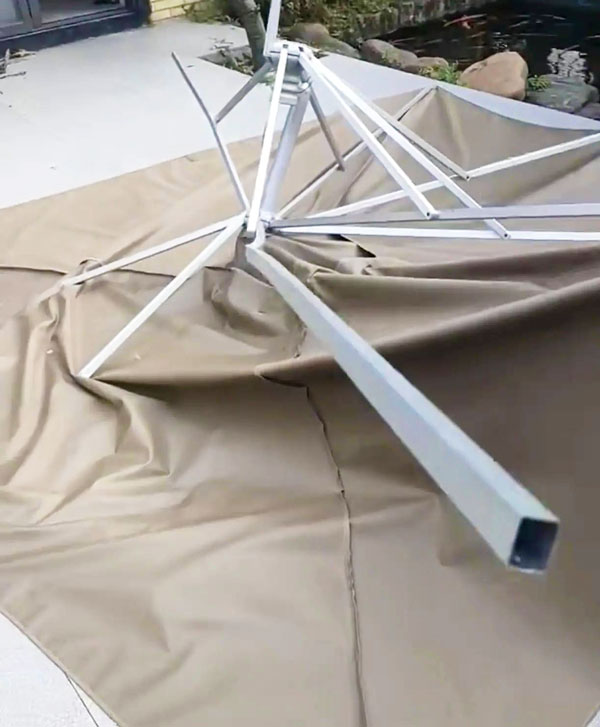
To answer this question, LIDA OUTDOOR’s garden umbrella design experts will detail the true wind-resistance capacity of cantilever umbrellas, guide you in selecting a genuinely wind-resistant model with seven steps, and provide seven practical tips to maximize your umbrella’s stability in windy conditions. We hope this information is helpful.
How Much Wind Can a Cantilever Umbrella Withstand?
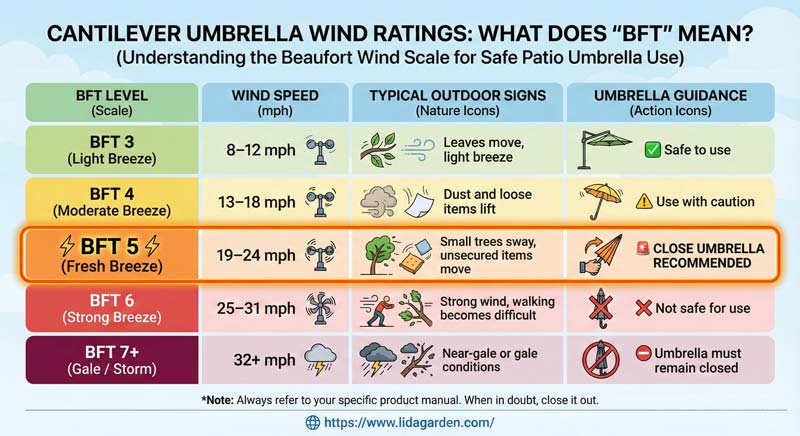
You may have seen some manufacturers advertise, “Our umbrellas can withstand BFT (Beaufort Scale) 6–7 winds or even higher,” which roughly corresponds to wind speeds of about 25–38 mph. In typical outdoor conditions, this wind speed is strong enough to move large branches and make walking uncomfortable.
These claims are not entirely false, but it is essential to understand the underlying conditions. Such tests are usually conducted at constant wind speeds in controlled environments, free of surrounding turbulence or eddies, with fixed wind direction, angle, and duration, and often with a specific base weight. In real-world outdoor use, however, wind rarely behaves this way. It usually arrives in gusts, with sudden changes in speed and direction, which makes true BFT 6–7 performance difficult to achieve in everyday patio settings.
For practical use, once wind speeds approach or exceed 20 mph (approximately BFT 5), it is best to close the umbrella. This is also our recommendation, and it is consistently confirmed by feedback from end users and customer representatives.
Manufacturer’s Advice: How to Select a Wind-Resistance Cantilever Umbrella? 7 Tips
Knowing the safe wind speed range for cantilever umbrellas, the next critical question is how to select an umbrella that is more stable and reliable in windy conditions. Below, we share seven practical tips.
1. Focus on the material.
Cantilever umbrellas are typically constructed from aluminum alloy, steel, or iron. Of these options, aluminum alloy is generally the most recommended due to its nice performance characteristics. It offers a balanced combination of strength and flexibility and exhibits better corrosion resistance than steel and iron.
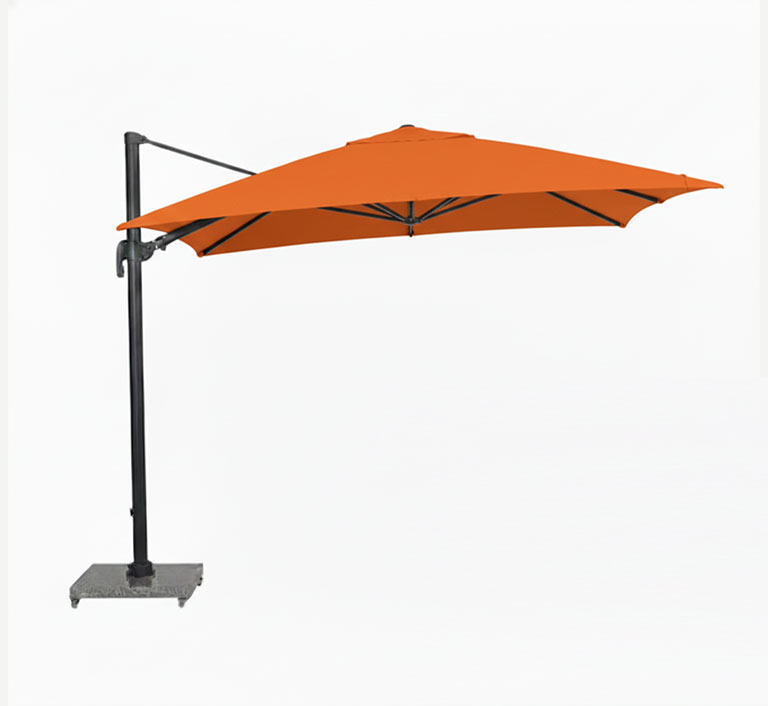
Furthermore, aluminum alloy improves safety in failure by producing a dull fracture, unlike the sharp cracks of steel or iron, which significantly reduces the risk of injury. This is why high-end cantilever umbrellas generally use aluminum-alloy frames.
2. Examine the Rib Structure (Number and Thickness)
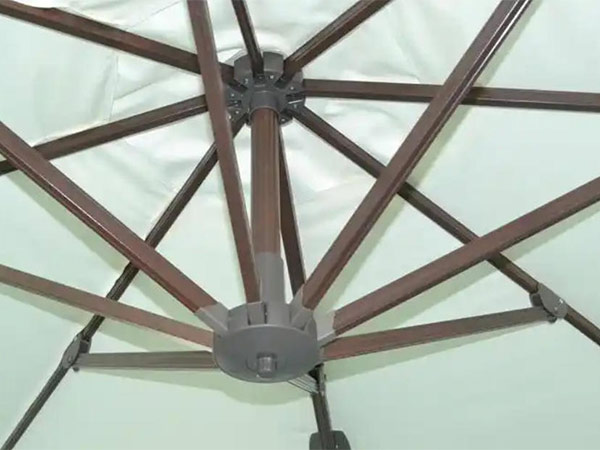
Broken ribs are a common vulnerability in cantilever umbrellas. Thicker, stronger ribs substantially mitigate this risk. The number of ribs is also critical for stability; an 8-rib structure is inherently more stable than a 6-rib one, providing better support and greater resistance to wind-induced wobble or deformation.
3. Canopy Design: With or Without a Wind Vent
If you live in a windy area, choosing a canopy with a wind vent is generally safer and more reliable. A vented canopy allows airflow to escape through the top, reducing pressure buildup that can cause the canopy to “balloon” and improving stability during gusts.
By contrast, umbrellas without a wind vent are more likely to catch the wind like a sail in strong conditions. This increases the risk of tipping or structural damage.
4. Locking System (Rotation & Tilt Locks)
In a cantilever umbrella structure, the locking system is just as important and should not be overlooked. Whether it is a rotation lock or a tilt lock, its purpose is to prevent excessive canopy movement under wind load by keeping the structure firmly secured.
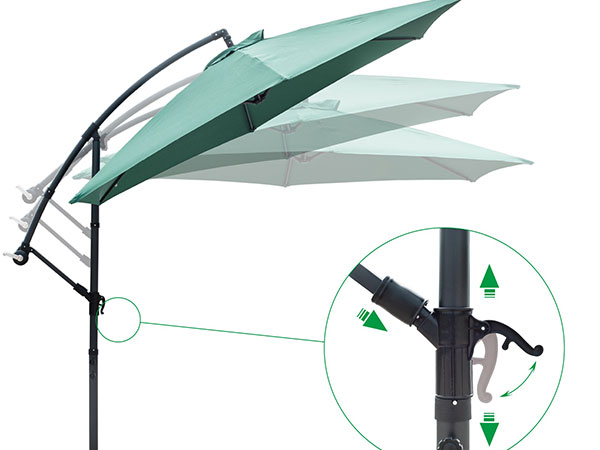
If the locking mechanism is not tight enough, the canopy is more likely to be pulled by gusts, increasing the risk of structural failure or tipping. Therefore, when choosing a cantilever umbrella, ensure the locking system is solid and reliable, and confirm it is properly locked during use to ensure stability in windy conditions.
5. Base Configuration (Often Overlooked)
Many cantilever umbrella failures are not caused by the umbrella itself, but by a base that is simply too light. In fact, most tipping cases are directly related to insufficient base weight.
Granite base for garden umbrella
There are three main types of bases:
- Water-filled bases: Affordable and convenient, but they offer limited stability because the water-filled weight is low.
- Sand-filled bases: They provide greater weight and stability but can be challenging to move.
- Granite bases: The most stable and durable option, these offer superior performance but are also the most expensive.
Regardless of the type you choose, the most important step is to confirm that the base weight is correctly matched to the umbrella size and local wind conditions—only then can true stability be ensured.
6. Size and Shape (Square Canopies Are More Wind-Resistant)
Before purchasing, you may be tempted to choose a larger umbrella to cover more shade. However, a larger canopy also means a greater wind-catching area, which places higher demands on both the frame and the base.
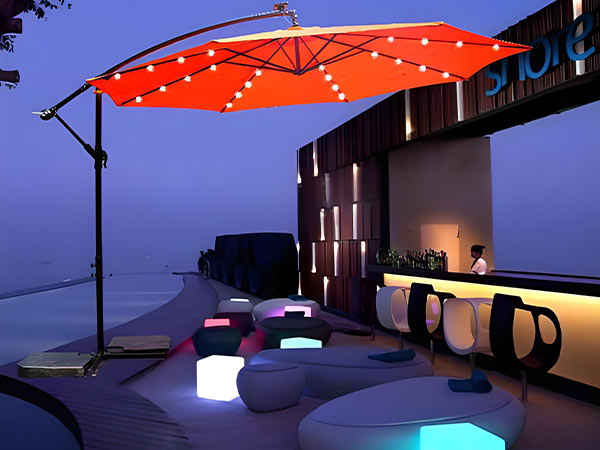
In addition, for the same size, square canopies are generally more stable than round ones, as their edges distribute wind force more evenly and are less likely to be lifted by side winds. Therefore, when selecting a cantilever umbrella, you should consider not only the size and base weight, but also whether the canopy shape is suitable for the wind conditions in your area.
7. Wind-Resistance Reference Setup
To simplify the selection process, wind resistance can be understood as a basic configuration checklist. A cantilever umbrella that remains stable in windy conditions typically includes an aluminum-alloy frame, eight or more ribs, a high-density canopy fabric weighing approximately 240 g, a vented canopy, and a heavy-duty base matched to the umbrella size.
If these key elements are properly aligned during selection, daily stability can generally be ensured, and the umbrella is less likely to sway even in light wind.
Improve Wind Resistance for Cantilever Umbrella
If you have already purchased a cantilever umbrella and are not fully confident in its wind performance during daily use, there are seven practical ways to improve stability and reliability in windy conditions.
1. Increase Base Weight (Most Effective Method)
The most direct and effective way to reduce wind resistance is to increase the base’s weight. Because a cantilever umbrella has an offset center of gravity, wind creates a tipping moment on the canopy, and the base must provide sufficient counterbalance.
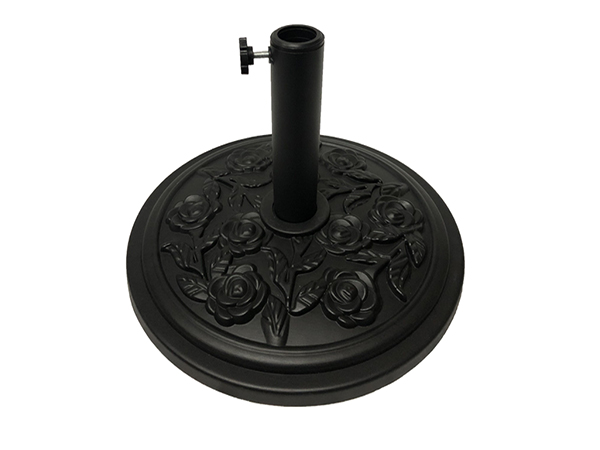
For this reason, the base weight should be significantly greater than the umbrella’s weight, and larger canopies require proportionally heavier bases. In coastal or open areas with stronger winds, additional weight is often required. The simplest solution is to add sandbags, wind weights, or granite slabs to the base to improve stability during gusts.
2. Use Ground Anchors or Bolts
If your cantilever umbrella is installed on a wooden deck or a concrete surface, fixing the base directly with bolts or dedicated ground anchors is one of the most effective ways to improve stability. This can significantly reduce movement in windy conditions and help prevent tipping caused by base shifting.
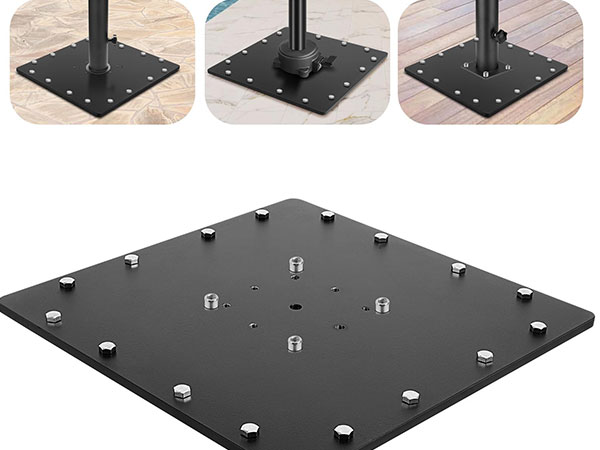
However, if the umbrella is placed on an unstable surface or loose paving tiles, ground anchors are not recommended.
3. Use Tie-Down Straps or Wind Ropes
If you live in an area with frequent strong winds, adding tie-down straps or securing ropes can provide additional support. The straps can reduce the movement of both the canopy and the frame. In this way, it allows the wind loads to be distributed more evenly.
The method is simple: secure the straps at the connection point between the frame and the base, or to the anchor rings extending from the base, so that the load is carried by the metal structure. This helps stabilize the umbrella without damaging the canopy.
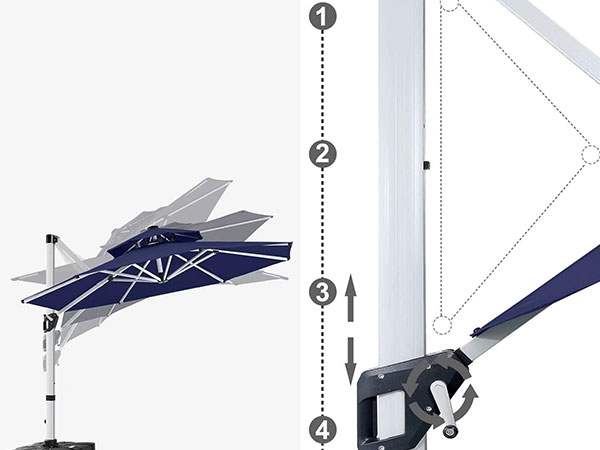
4. Adjust the Tilt Angle to Reduce Wind Resistance
From an aerodynamic standpoint, adjusting the tilt angle improves airflow and reduces wind load on the umbrella. In consistently windy spots, tilting the canopy 10°–20° slightly toward the wind is often more stable than leaving it upright. When the canopy is angled, wind flows along the surface rather than striking it directly, reducing drag and tipping force.
5. Avoid Improper Use Scenarios
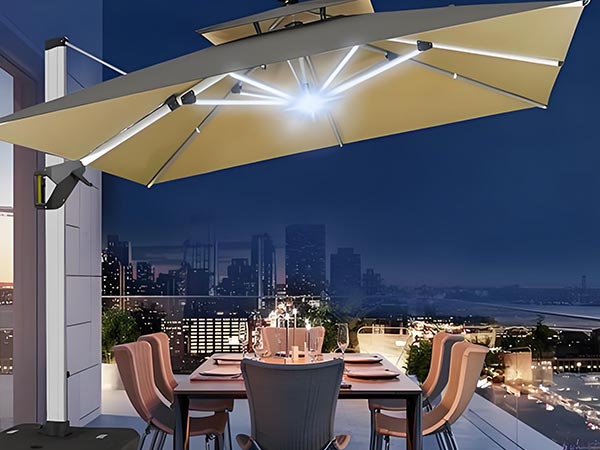
Even a good cantilever umbrella can become unstable depending on where you put it. Places like rooftop terraces and high decks experience much stronger, more unpredictable winds. If the base isn’t heavy enough or securely anchored, a sudden gust of wind can easily lift or knock the umbrella over.
6. Regularly Check Locks and Bolts
Rotation locks, tilt locks, and bolts should be inspected and tightened regularly. Once these components loosen, movement under wind load can increase rapidly, raising the risk of damage. Routine checks help maintain and improve the cantilever umbrella’s overall stability.
7. Close the Umbrella at 20 mph (Critical Safety Notice)
No matter how strong the structure is, once wind speed approaches 20 mph (approximately BFT 5), conditions already become unsafe, and the umbrella should be closed immediately. In winds above 30 mph (BFT 7), no type of umbrella is recommended for use.
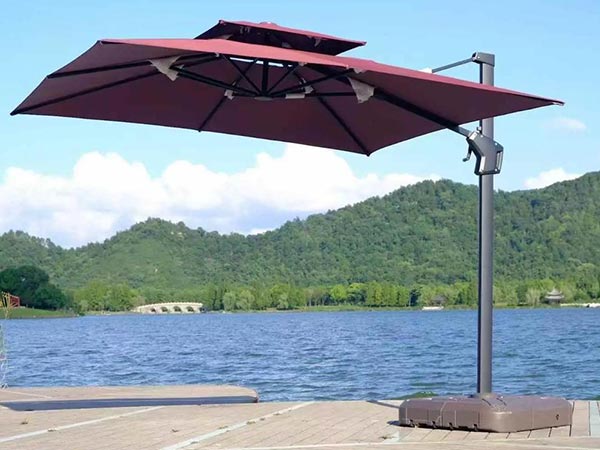
We emphasize this point to promote safety in real-world conditions, as adhering to these wind-speed guidelines often better protects the umbrella and extends its service life than relying on paper specifications alone.
Conclusion
In summary, understanding realistic wind limits, selecting the appropriate structure, and using proper setup methods are key to achieving stable cantilever umbrella performance in windy conditions. When these factors are correctly addressed, everyday use becomes far more predictable and secure.
As a China-based manufacturer of outdoor shade products, LIDA OUTDOOR focuses on wholesale supply and large-volume production of cantilever umbrellas. We share these practical insights to help buyers, brands, and project planners make more informed decisions based on real-world use rather than marketing claims.