
When enjoying a sunny afternoon in your patio, garden, or balcony, the right umbrella does far more than provide shade — it defines comfort, atmosphere, and style. From frame structure and stability to fabric, functionality, and price, every detail affects how your outdoor space looks and feels.
At LIDA OUTDOOR, our designers study and collect different patio umbrella types each year to inspire new designs and improve product performance. Based on years of practical experience, we’ve summarized 12 of the most common patio umbrella types, explaining their structures, features, and suitable applications to help you make informed choices for both home and commercial spaces.
Patio Umbrella Types and Applications

Before diving into each style, it’s helpful to understand the logic behind our classification. Knowing how these umbrellas are grouped will make it easier to see how different structures and functions relate to one another.
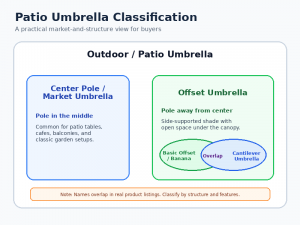
From a structural standpoint, almost every patio umbrella falls into one of two core categories: the center pole umbrella, where the pole sits directly in the middle of the canopy, and the cantilever umbrella, which supports the canopy from the side to create an open, flexible shaded space.
Beyond these two fundamental designs, patio umbrellas can also be classified by canopy shape, special structure, or functional features — such as half umbrellas, wall-mounted models, sail-shade designs, or solar-powered umbrellas with lighting.
To help you quickly get an overview, we’ve organized these into the following table, showing 13 representative patio umbrella types, their typical use scenarios, and general price levels.
| Category Level | Type Name | Typical Applications | Price Range |
| Ⅰ. Core Structural Types | Center Pole Umbrella | Outdoor dining tables, balconies, cafés | ⭐⭐ |
| Cantilever Umbrella | Poolside areas, lounges, and large patios | ⭐⭐⭐ | |
| Ⅱ. Functional Variations | Tilting Umbrella | Small courtyards, west-facing spaces | ⭐⭐⭐ |
| Rotating Cantilever Umbrella | Pools, patios, and flexible lounge setups | ⭐⭐⭐⭐ | |
| Commercial-grade Umbrella | Hotels, restaurants, public walkways | ⭐⭐⭐⭐⭐ | |
| Beach Umbrella | Beach, lakeside, temporary shade areas | ⭐ | |
| Ⅲ. Special or Space-Adaptive Types | Half Umbrella | Balconies, porches, narrow spaces | ⭐⭐ |
| Wall-mounted Umbrella | Storefronts, verandas, and small terraces | ⭐⭐ | |
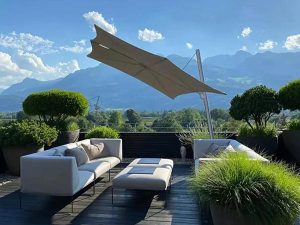
| Sail Shade Umbrella | Gardens, resorts, landscape zones | ⭐⭐⭐⭐ | |
| Ⅳ. Feature Enhancements | Solar Umbrella | Nighttime patios, cafés, and garden lighting | ⭐⭐⭐ |
| Double-top Ventilation Umbrella | Coastal areas, hot climates, pool decks | ⭐⭐⭐⭐ | |
| Waterproof & UV-resistant Fabric | High-sunlight or long-term outdoor use | ⭐⭐⭐⭐ | |
| Heavy-duty Base & Mobility | Large cantilever umbrellas, commercial zones | ⭐⭐⭐ |
Additional Note: Of course, patio umbrellas also differ significantly in frame materials and canopy fabrics — from aluminum, steel, and wood structures to polyester and acrylic textiles. These differences affect weight, durability, and appearance. Since this article focuses mainly on structure and functionality, we’ll cover materials and fabrics in a dedicated follow-up guide.
Ⅰ. Core Structural Types
The supporting structure is the foundation of all patio umbrella types. In this section, we’ll start with the two most common and fundamental designs that shape almost every umbrella on the market today.
1. Market / Center Pole Umbrella
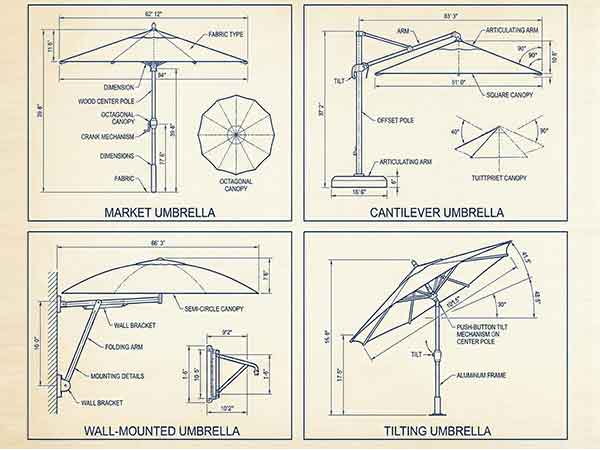
The market or center pole umbrella is the most classic and widely used patio umbrella design. The pole stands in the middle of the canopy, providing symmetrical balance and strong overall stability — a timeless structure that fits both residential and commercial spaces.
It’s commonly found in outdoor dining setups, café patios, hotel courtyards, and home gardens. The main advantages include simple operation, easy maintenance, and compatibility with various furniture layouts. One of the most popular versions is the table umbrella, in which the pole passes through the center hole of a table and anchors into a base, creating steady, space-efficient shade.

However, because of the offset structure, cantilever umbrellas rely heavily on a solid, weighted base or fixed installation to ensure safety and stability. When choosing one, it’s recommended to select models with locking rotation systems or cross-shaped heavy-duty bases to improve wind resistance and durability.

2. Cantilever Umbrella
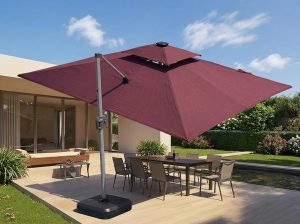
The cantilever umbrella, also known as an offset umbrella, positions its pole to one side and suspends the canopy using a horizontal or curved support arm. This allows the shaded area to remain fully open underneath, making it perfect for poolsides, lounge areas, outdoor cafés, and commercial patios.
Its advantages lie in its flexibility and aesthetics — the off-center design provides wide, unobstructed coverage while maintaining a clean, modern look. Many cantilever umbrellas also support tilt adjustment and 360° rotation, allowing precise shading throughout the day.

Ⅱ. Functional Variations
After understanding the two core patio umbrella structures, let’s move on to designs that prioritize functional adaptability. These umbrella types enhance the basic structure with adjustable angles, rotation, or portability, meeting specific usage demands in different environments.
3. Tilting Umbrella
The tilting umbrella allows users to adjust the canopy’s angle as the sun moves throughout the day. With a simple push button or crank mechanism, the umbrella head can be tilted to block sunlight from different directions — making it ideal for balconies, small courtyards, and west-facing terraces.
Its biggest advantage lies in flexibility. It provides consistent shade from morning to afternoon without needing to move the base. However, since the tilting joint introduces an extra hinge, it’s slightly less wind-resistant than fixed-pole models. In windy conditions, it’s best to close the umbrella to ensure safety.

4. Rotating Cantilever Umbrella
The rotating cantilever umbrella takes flexibility to a whole new level. Supported by a side pole and pivot mechanism, this umbrella can rotate 360° horizontally and tilt at multiple angles. You can easily adjust the shade direction based on the sun’s position or furniture layout — perfect for poolside areas, outdoor lounges, and commercial patios.
Compared to a standard cantilever umbrella, this version allows full-day shading without moving the base. While the added rotation mechanism increases weight and cost, it delivers superior usability and comfort. For users who value all-day flexibility and premium quality, this is one of the best patio umbrella types available.

5. Commercial-grade Umbrella
A commercial-grade umbrella is a heavy-duty model built for long-term, high-frequency outdoor use. It can be either a center pole or cantilever structure, but is made with thicker aluminum or stainless-steel frames and high-performance acrylic fabrics for durability.
This type is designed for hotels, restaurants, resorts, and other high-traffic outdoor areas. It offers excellent stability, large canopy coverage, and a long lifespan even under constant exposure to sun and wind. While these umbrellas are heavier and more expensive, they’re ideal for professional or semi-permanent installations where strength and visual quality matter most.


6. Beach Umbrella
Lightweight and portable, the beach umbrella is designed for temporary shading on beaches, lakesides, and picnic areas. It usually features a slim pole with a pointed end that can be anchored directly into sand or soft ground.
Its main advantages are convenience and mobility — easy to carry, quick to set up, and simple to adjust. However, because of its lightweight structure, it’s less stable in strong winds and best used for casual or short-term outdoor shading. If you prioritize portability over permanence, the beach umbrella remains a classic summer essential.

Ⅲ. Special or Space-Adaptive Types
Most patio umbrellas feature independent pole structures with round or square canopies, designed primarily for open outdoor spaces. However, not every area offers such freedom. In tighter or architecturally constrained settings, traditional umbrellas can feel bulky or impractical.
The following umbrella types are created to solve those spatial challenges. They focus on adaptability and integration, providing shade solutions for narrow, wall-adjacent, or visually distinctive environments.
7. Half Umbrella
The half umbrella features a semi-circular or half-rectangular canopy with a straight backside that sits flush against a wall or railing. It’s purpose-built for balconies, porches, small courtyards, or storefronts where a full umbrella would take up too much space.
Its key benefit is its compactness — it delivers functional shade in narrow areas while maintaining a clean, balanced appearance. However, since it shades only in one direction, it offers limited angle adjustment and less wind resistance. When combined with a wall-mounted base or secure anchor system, it becomes an efficient solution for space-constrained outdoor areas.

8. Wall-mounted Umbrella
Unlike traditional models, the wall-mounted umbrella attaches directly to a wall via adjustable metal arms, eliminating the need for a vertical pole or ground base. This design completely frees up floor space, making it ideal for balconies, shopfronts, cafés, and covered terraces where space for movement is limited.
The adjustable arm mechanism allows users to extend, retract, or angle the canopy based on sun position or desired coverage. It not only saves valuable ground area but also enhances the overall architectural look, blending functionality with modern design. Though installation requires a strong supporting wall, once set up, this umbrella type offers reliable shade with zero footprint.

Ⅳ. Feature Enhancements
Beyond structural differences, some patio umbrella types stand out for their functional upgrades — such as lighting, ventilation, fabric protection, and mobility improvements. These features don’t redefine the umbrella’s shape but greatly enhance its comfort, usability, and durability in daily use.
9. Solar Umbrella
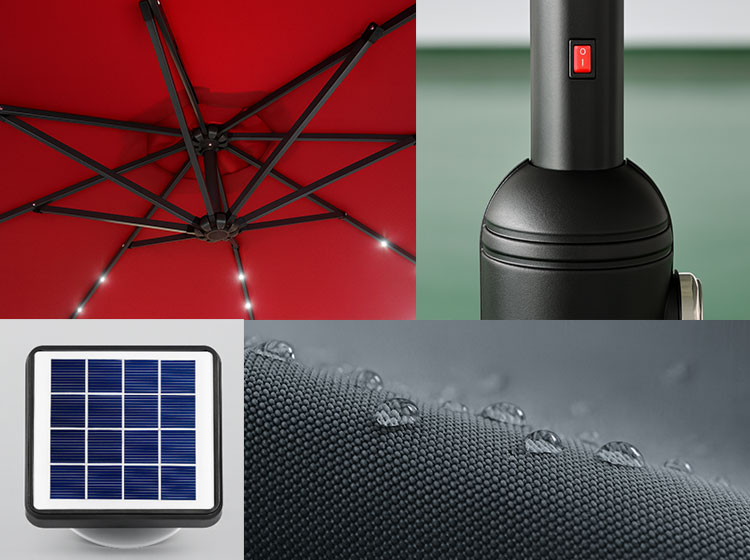
The Solar Umbrella integrates solar panels at the top of the canopy, powering LED lights embedded beneath. This setup allows soft nighttime illumination without external wiring, making it ideal for restaurants, patios, and garden lounges that operate after sunset.
Its main strengths lie in sustainability and convenience — easy to install, energy-efficient, and visually appealing after dark. However, the solar system adds extra weight to the canopy and a slightly higher cost, making it best suited for users who value both ambience and eco-friendliness.
10. Double-top Ventilation Umbrella
The double-top ventilation umbrella features a two-tier canopy design that allows air circulation between the upper and lower layers. This airflow helps release trapped heat and reduce wind pressure, resulting in better stability and comfort in hot or breezy environments.
Commonly used in coastal areas, poolside decks, and tropical resorts, this structure not only performs well functionally but also adds an elegant, layered look. While it enhances airflow, it should still be paired with a heavy base or secure anchor in high-wind regions.
11. Waterproof & UV-resistant Fabric
The canopy fabric largely determines an umbrella’s performance and lifespan. Waterproof and UV-resistant fabrics are among the most essential upgrades for high-quality patio umbrellas. Typically made from polyester or acrylic materials, these fabrics receive special coatings or treatments to withstand sunlight, rain, and fading.
Waterproofing keeps the surface dry in light rain, while UV resistance prevents color fading and fabric degradation from prolonged sun exposure. These materials are particularly suited for high-sunlight regions and long-term outdoor installations. When choosing an umbrella, check for a UPF 50+ rating and fabric weight to ensure optimal protection and longevity.
12. Heavy-duty Base & Mobility
A stable base is the foundation of every safe patio umbrella setup. The heavy-duty base is typically made of steel, concrete, or fillable plastic that can be loaded with water or sand to increase weight. Some models even feature built-in wheels for easy movement without disassembly.
For larger or cantilever umbrellas, a reinforced cross base or in-ground mounting system is often necessary to prevent tipping in windy conditions. When evaluating bases, consider both weight capacity and mobility — these two factors directly determine stability, safety, and overall ease of use.

Conclusion
Choosing the right patio umbrella is about more than just size or appearance — it’s about matching structure, function, and design to your unique outdoor environment. Whether you prefer the stability of a center pole umbrella or the versatility of a cantilever design, each type serves a distinct purpose, balancing comfort, coverage, and aesthetics.
Before making a purchase, consider your space layout, the direction of sunlight, installation options, and long-term durability. These factors will help determine which umbrella type best complements your lifestyle or business needs. If you’re exploring high-quality patio umbrellas from China, browse LIDA OUTDOOR’s full range of designs to find the perfect combination of style, function, and value for your outdoor space.
Looking to source patio umbrellas from China? Explore our full range of high-quality umbrellas at LIDA OUTDOOR >